While solar energy currently constitutes only a very small fraction of the total energy mix (about 2%) and electricity production (about 4.5%), it is a rapidly growing resource and it is a resource with enormous untapped potential – particularly in lower income countries in the tropics which receive abundant sunshine year round. Fundamentally, there is enough solar energy incident on the surface of the Earth to provide the world’s energy needs many times over. The challenges are with technology, space, cost, storage and distribution. Solar does have the same intermittency issue that wind does in that a solar plant cannot produce electricity at night, in fog or under significant cloud cover.
However, it should be noted that some of the global leading countries and regions in solar deployment are not stereotypically dry, cloudless environments in the tropics. China is the global leader in solar PV technology, followed by the US, but adjusted for population, Japan, Netherlands and Germany are all among the top 5. The constraint on the resource is much more about technology development and mobility than natural resources. The graphic below shows the global leaders as of 2021 in per capita solar use, added PV capacity and total installed PV capacity.
source: https://solarpower.guide/solar-energy-insights/countries-solar-power-consumption

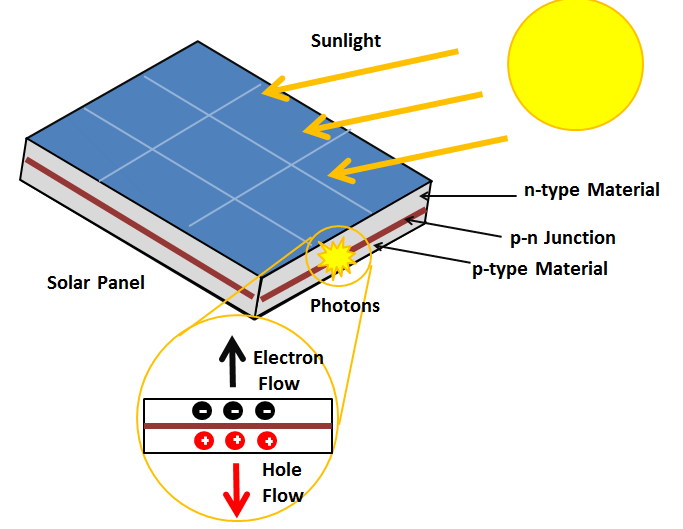
Photovoltaics: The most common form of solar energy technology by far is the photovoltaic (PV) cell or panel. PV cells are made of silicon panels (usually mono or polycrystalline) which acts as a semiconductor, using the photovoltaic effect to convert solar energy into direct current electricity. The energy of photons from the sun causes electrons in the valence band of silicon to jump to the conduction band. The excited electrons are then accelerated to a material with a built in electric potential, inducing an electromotive force. With crystalline silicon, p-n junctions are typically used. Diagrams of how a typical PV cell works are shown below
source: https://energyeducation.ca/encyclopedia/Photovoltaic_cell
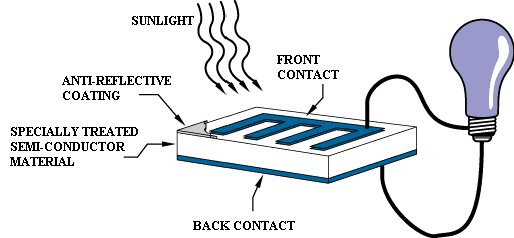
The price of PV panels has fallen rapidly in the recent past, but so too has their value. On balance, however, the benefits have outweighed the costs.
source: https://news.mit.edu/2020/researchers-find-solar-photovoltaics-benefits-outweigh-costs-0623

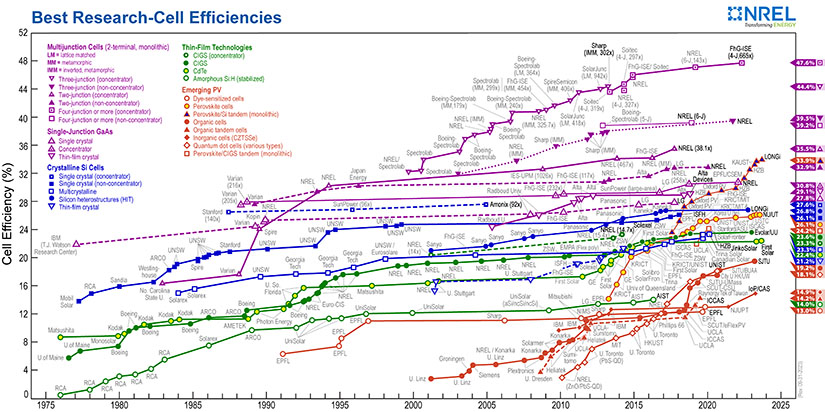
PV technology is very prevalent but not as efficient as other technologies. Efficiency has gradually been improving, especially with multi-junction panels, but overall solar to electric conversion efficiency remains below 50% for all technologies. The chart below from the National Renewable Energy Lab shows the conversion efficiency of different PV technologies over time.
source: https://www.nrel.gov/pv/cell-efficiency.html
Solar PV can easily be used for individual homes and businesses. But because of the intermittency issue, storage is a challenge.
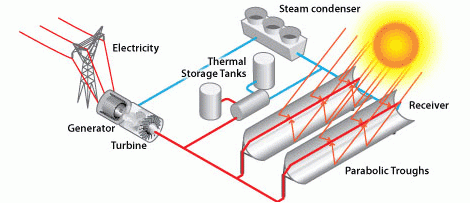
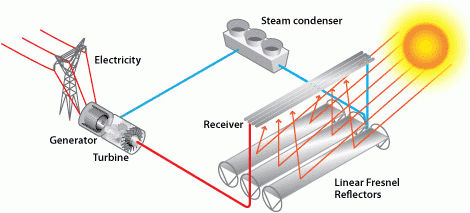
Thermal: Another type of solar energy technology involves converting solar energy into thermal energy. The solar energy is reflected and focused by onto an absorber tube which gets very hot. This tube is filled with a thermal conducting fluid (such as synthetic oil or molten salt), which can heat to several hundred degrees C. The heat is then transferred to water, which boils and drives a steam turbine leading to electricity production.
There are several designs: power towers, parabolic mirrors, enclosed parabolic mirrors, dish designs and Fresnel reflectors. Solar thermal technology can potentially function at a higher efficiency than PV technology and the higher the temperature of the absorber fluid, the higher the potential efficiency. It’s also easier to store thermal energy than electricity, so there is less intermittency and greater potential for large scale production. However, cost is a limiting factor and there are currently only a handful of very large facilities.
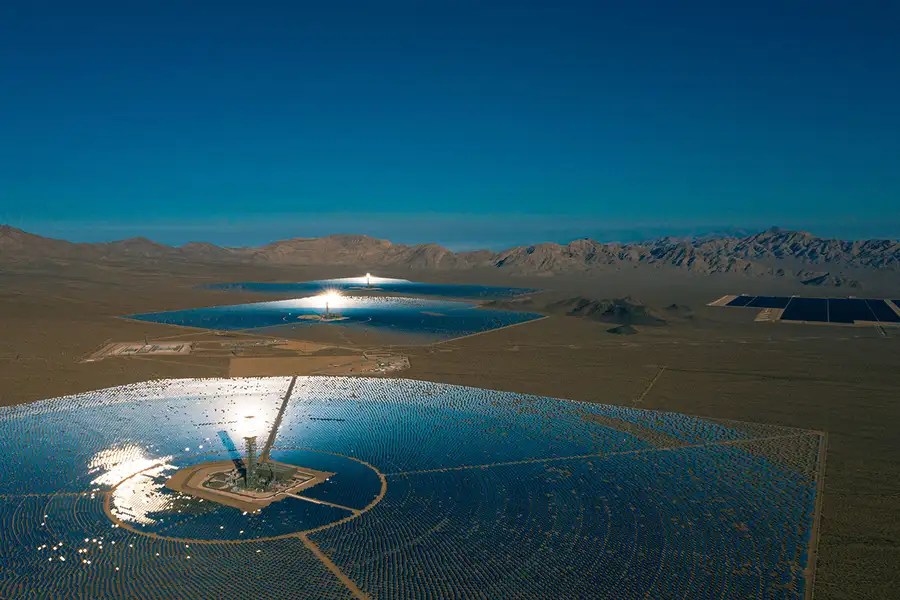
The largest “power tower” design in the world is in the Mojave desert and is depicted in the image below and uses almost 200000 mirrors. This project has come under some measure of environmental scrutiny because of its impact on birds (who think the mirrors are a body of water and then get to close to the searing heat) and desert tortoises (whose habitat is disrupted).
Parabolic mirror and fresnel reflectors can be used on a much physically smaller scale in a more widespread manner and schematic diagrams are shown below.
Thin Films: While standard crystalline PV cells and solar thermal technology have been around for a long time, more recently, a newer form of solar technology has been developed involving using thin, flexible films of photovoltaic material. These films are typically on the order of nanometers to micrometers (standard PV cells are typically about 300 times thicker) and are placed on a flexible substrate. The first research in this arena was conducted in the 1970s and early large scale production began in the 1990s.
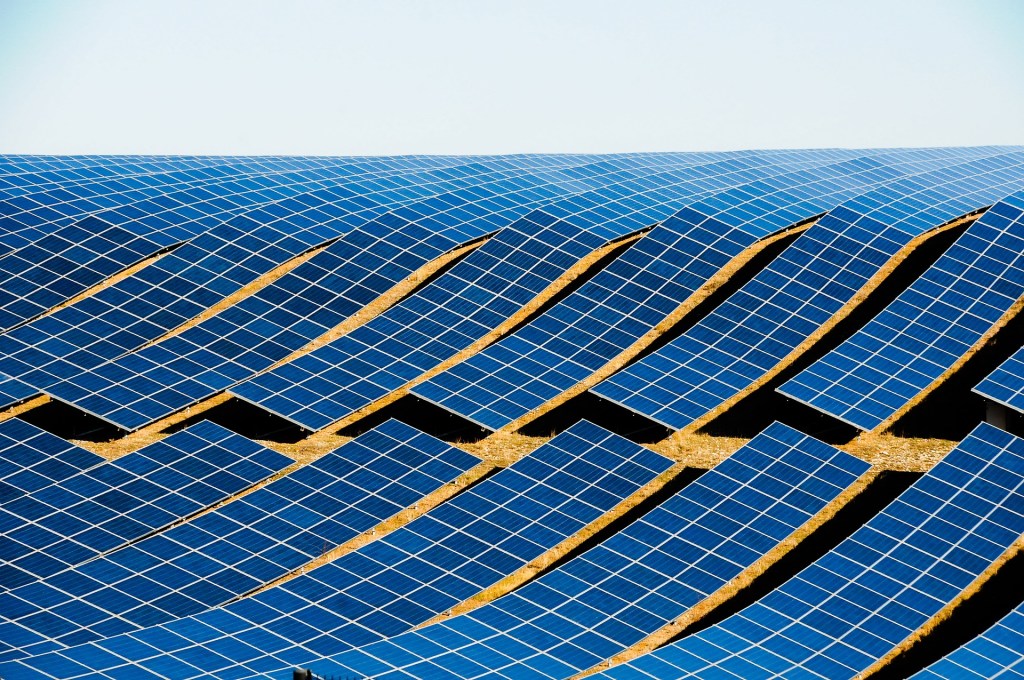
Thin films are still fundamentally PV technology, but can be made with amorphous silicon, thin film silicon (a-Si), cadmium telluride (CdTe), gallium arsenide GaAs, copper indium gallium selenide (CIGS). There are several perceived advantages to using thin films – mainly they are less costly, more flexible, more high temperature tolerant, generate less waste, and require less material. They also have the theoretical potential to have higher efficiency, and as of 2023, the most efficient thin films convert about 29% of solar energy to electricity – which is slightly higher than standard PV cells. But many types of thin films still operate at a lower efficiency than standard monocrystalline or polycrystalline PV cells. Market penetration is a function of supply, cost and efficiency. Some thin film materials can be grown organically. However, they still constitute a relatively small share of the total solar market, and the lower space efficiency means that home heating and electric applications are impractical. However, the physical flexibility of solar films opens the door for new applications, especially for moving components. Below is a photo of thin film solar panels.
source: https://ases.org/thin-film-solar-panels/
Below is a comparison of the typical cost, efficiency and life span of monocrystalline, polycrystalline and thin film solar panels.
source: https://www.greenmatch.co.uk/blog/2014/11/how-efficient-are-solar-panels

 asclimateservices.org