Conventional: Conventional geothermal energy technology extracts thermal energy from naturally occurring environments where magma near the surface heats surface water. This thermal energy results from the radioactive decay of minerals and from warm material being brought to the surface by upper mantle convection. The total global installed capacity of geothermal energy in 2023 is on the order of 16 GW. It has several advantages over solar, wind, biofuels and hydropower – in that the natural resources are usually constant (not intermittent), and it requires less land and produces less noise than other sources. It also allows for recycling both components and thermal energy.
Historically, geothermal energy has been used primarily for electricity and heating, although there are some applications for cooling in recent years. The US, Philippines, Indonesia, Turkiye and New Zealand are the global national frontrunners in geothermal energy production. Proportionally to the population, the clear national leader is Iceland – for which about 65% of the nation’s energy comes from geothermal sources. The significant limitation to conventional geothermal energy is that it is only practically viable in tectonically active areas near geophysical plate boundaries. This limits its potential.
source: https://www.eia.gov/energyexplained/geothermal/geothermal-power-plants.php
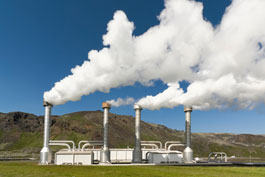
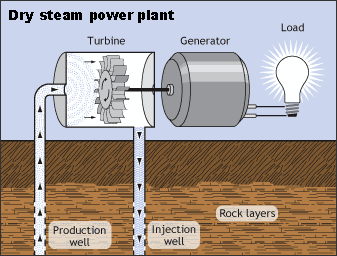
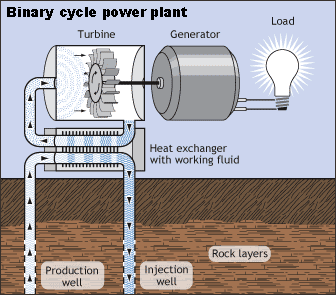
Two of the common types of geothermal plants are a flash steam plant and a binary cycle geothermal plant. Flash steam plants typically involve a lower water pressure than normal to produce steam and binary cycle geothermal plants can use moderately warm water to heat a secondary fluid with a lower boiling temperature. In either case, the steam that is generated then drives a turbine to produce electricity as depicted in the schematic diagram below.
source: https://www.eia.gov/energyexplained/geothermal/geothermal-power-plants.php

Ground-source: While conventional geothermal energy is most concentrated near tectonic plate boundaries, a more limited geothermal
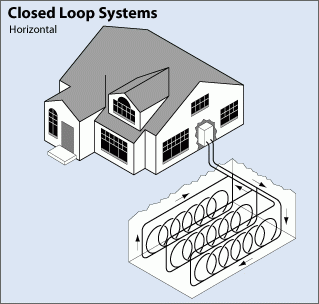
energy, called ground-source geothermal energy can be used pretty much anywhere. Pretty much anywhere in the world, the temperature about 6 meters below the surface is close to constant around the region’s average temperature (and seasonal temperature changes are minimized). Ground source geothermal energy is most commonly used for HVAC systems. This technology can dramatically limit the need for additional heating and can pretty much eliminate the need for air conditioning in many mid-latitude and higher latitude climates.
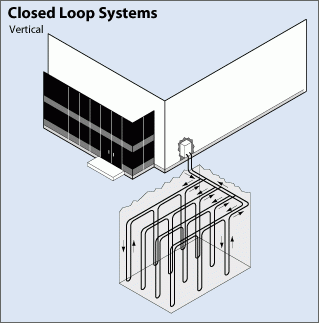
There are several techniques including a direct exchanger, ground source exchanger or water source exchanger and may involve either closed or open loops and either vertical or horizontal wells. Globally, there are about 190 million such units in operation as of 2023 and there is an ambition to scale this up to 600 million by 2030. Typically horizontal systems are best for residential use, whereas vertical systems are more commonly used for commercial applications because the space requirements of having a horizontal design for a commercial building are usually prohibitive.
source: https://www.energy.gov/energysaver/geothermal-heat-pumps
A more general schematic can be found here
source: https://energyeducation.ca/encyclopedia/Ground_source_heat_pump

 asclimateservices.org