Fission – small modular reactors
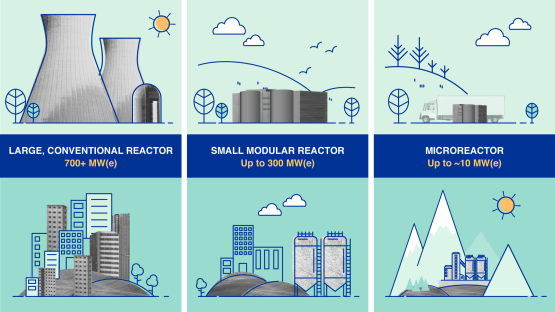
Nuclear fission is the process of splitting large atoms (usually uranium or plutonium) apart into smaller ones – usually by bombarding them with high energy and neutrons. This has been the manner in which all nuclear energy for civilian use has been created and is also the underlying technology behind all nuclear weapons. While nuclear reactors for civil energy production has produced about 4% of the world’s energy and about 9% of the world’s electricity, there are a number of undesirable aspects of this technology. For one thing, the waste product of nuclear fusion reactors is toxic and radioactive and must be dealt with effectively and safely. For another thing, there is always some measure of risk of nuclear meltdown if there is insufficient coolant directed to the reactor core (see the Chernobyl disaster). Another challenge with nuclear fission is that many large reactors take a long time to site and build, are built to last a long time, but many reactors built in the mid 20th century are approaching the end of their lives. Development of new “traditional scale” nuclear reactors is very capital intensive and involves all the risks mentioned above. There are also security risks.
source: https://www.iaea.org/newscenter/news/what-are-small-modular-reactors-smrs
Usually plants designed to produce nuclear materials for military weapons are completely separate from plants used for civilian purposes, because for both uranium and plutonium, nuclear weapons require a very high level of enrichment in the radioactive isotopes (far beyond what is required for civilian purposes).
An alternative to traditional large nuclear reactors which has received more attention in the context of climate change is the idea of developing more small, modular nuclear fission reactors. By being smaller and having components that can be produced off-site and then shipped to the reactor site, these types of reactors can be built more quickly, occupy a smaller footprint and don’t carry some of the dangers of a meltdown or radiation at a really large reactor.
For more information on small modular reactors, consult IAEA webpage on SMRs.
Fusion
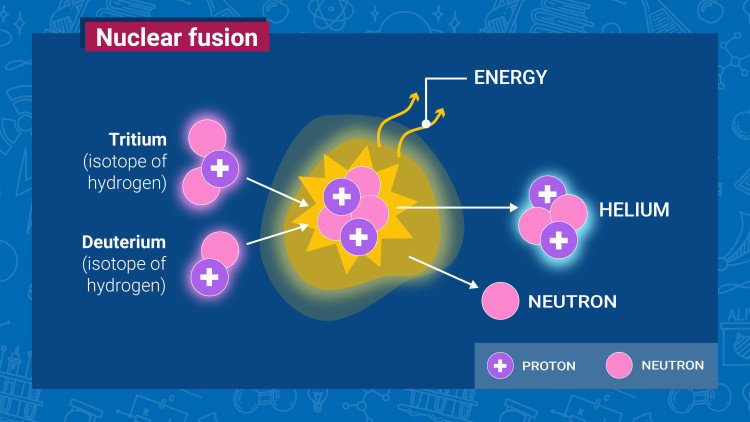
Nuclear fusion is the process by which energy is generated by the Sun and other stars and is a product of smashing small atoms (usually isotopes of hydrogen deuterium and tritium) together to form larger atoms. In the process, an enormous amount of heat is produced, but an enormous amount of energy is required. Fusion has thus far remained an elusive technology to master, but has long been considered the “holy grail” of alternative energies – because it produces no greenhouse gases, doesn’t have the intermittency issues, storage issues or land requirements of wind, solar and biofuels and doesn’t produce the toxic wastes or have the safety concerns of nuclear fission.
source: https://www.iaea.org/newscenter/news/what-is-nuclear-fusion
It’s very exciting that as of mid-December 2022, fusion research has achieved a major milestone: with a reaction at the Lawrence Livermore National Lab in California generating significantly more energy from a fusion reaction than was put into it. Here’s the NY Times article. This is really significant and the potential is enormous because of the nature of fusion and the constituents thereof. Fusion can provide abundant, safe energy with no fossil fuels, no issues with intermittency, no toxic byproducts, and no significant land or water requirements.
However, the amount of excess energy generated in the December 2022 reaction was enough to boil 2 and a half gallons of water or about one kilowatt hour of energy. The reaction has since been duplicated once in 2023 with similar yields. In 2021, the global primary energy production was on the order of 180 petawatt hours of energy (1 petawatt = 1 trillion kilowatts). So there is a need to scale up energy production by a factor of 180 trillion in order to meet current global energy demand fully, now that the first step of net positive energy production has been achieved. And no doubt, in the time it takes to scale up the capacity of fusion, the total global energy demand will increase yet further.
This is going to take some time. Furthermore, while we could potentially see fusion supplying all of our electric needs and perhaps the majority of our HVAC needs, liquid fuels (or fuel cells for certain types of cars) are still the form of energy needed for travel. There are obviously significant issues, not only with scaling, but with distribution of energy (both in space within affluent societies) and from the affluent world to the poorer parts of the world.
 asclimateservices.org