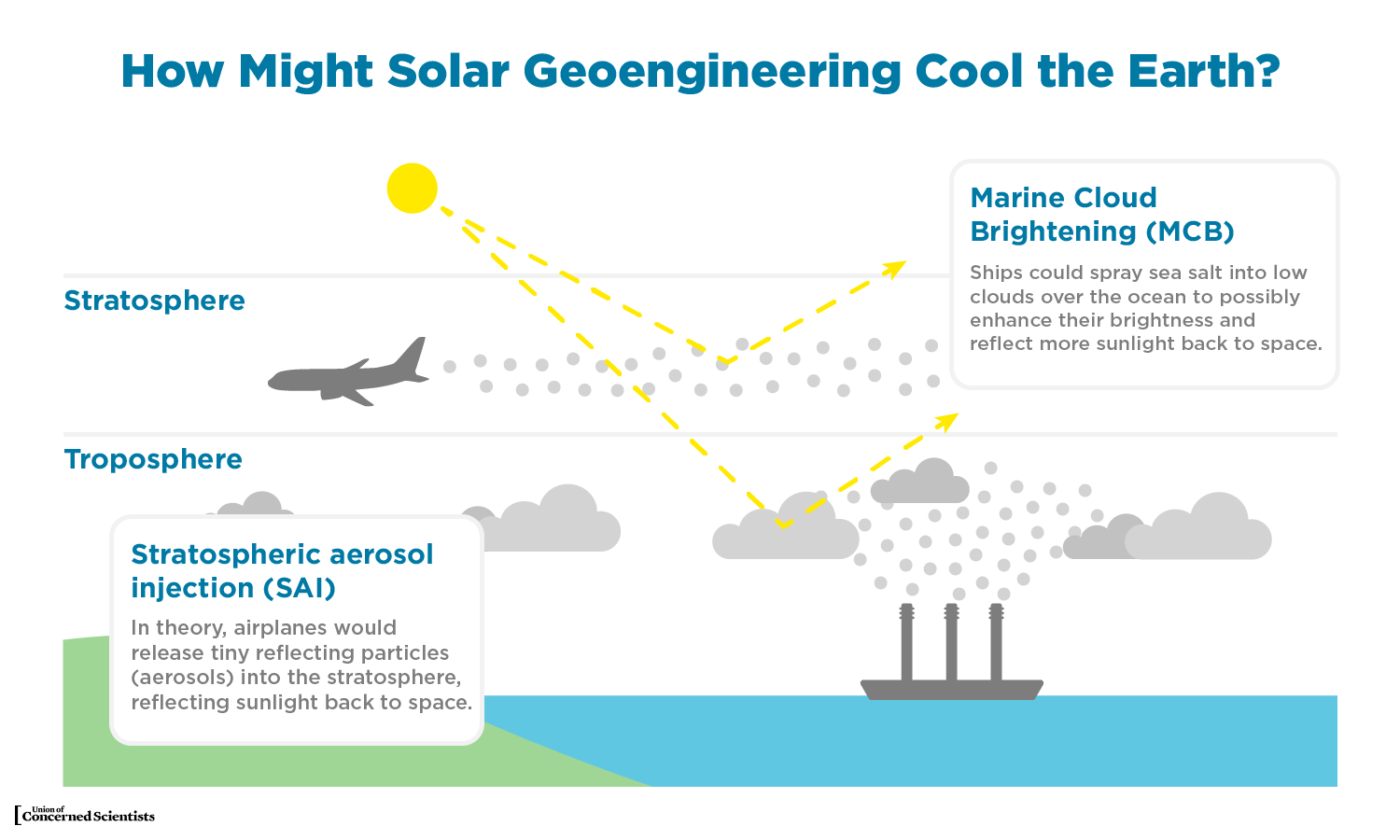
Like decarbonization strategies, the idea behind solar geoengineering is to address the climate challenge through means other than emissions reduction. Unlike decarbonization technologies, the goal with solar geoengineering is to literally reduce the net shortwave flux of solar energy to the Earth, by making the Earth’s surface and/or atmosphere more reflective.
Frankly, this is a bad idea and most serious scholars in the field consider all major solar geoengineering ideas to be accompanied by enormous costs, uncertainties and potential risks. With carbon/GHG issue, there is no obvious downside to pursuing the technologies other than the cost, safety of the individual technology and the scalability. The picture is a bit different for solar geoengineering.
Sulphate aerosols: The idea with sulphate aerosol injection is to (via aircraft) inject huge quantities of sulfate (SO2) into the stratosphere to cause a net negative radiative forcing (thereby increasing planetary albedo).
This is likely to be extremely costly with a number of potentially unexpected and problematic consequences. While sulphate aerosols do have a net cooling effect, they are also the key driver for acid rain and can produce other adverse health effects. Furthermore, sulphates in the stratosphere can form a substrate for chlorofluorocarbons or chlorine atoms to destroy ozone. Furthermore, if this were done at a scale to make a meaningful difference in the planetary albedo, there are published studies that suggest there could be a number of significant, negative or at least unpredictable consequences for the global climate (https://sgp.fas.org/crs/misc/R47551.pdf).
Marine cloud brightening: Another related idea is to spray sea salt from ships into low level clouds to get them to be brighter and thus more reflective.
Painting Surfaces: An idea with an arguably lower risk of adverse consequences is the idea of painting surfaces (particularly in urban settings) white or a lighter or more reflective color. This would increase the planetary albedo and wouldn’t necessarily have obvious negative side effects (other than perhaps to people’s sensibilities) and may even have some positive effects (white topped roofs in urban settings can sometimes be considerably cooler than black topped roofs in the same environment). But it’s highly unlikely that this could ever be done at a scale to make an appreciable difference for the global energy budget.
Space Mirrors: One of the crazier ideas out there is to put large mirrors in space to effectively increase planetary albedo by effectively blocking some of the incoming solar radiation. This is likely to be incredibly costly, with a highly uncertain outcome and potentially problematic outcome.
source: https://www.techtimes.com/articles/288444/20230302/gigantic-space-mirrors-cool-earth-un-suggests.htm

 asclimateservices.org