Another old alternative/renewable energy source has been wind energy – using the kinetic energy of wind to turn windmills connected to electricity generators. The major challenge to wind energy production is intermittency. The amount of energy produced from a wind turbine is proportional to the cube of the wind speed – so siting wind energy projects in areas with reliably strong winds is critically important. The theoretical maximum efficiency of conversion from kinetic energy to electricity is about 60% and is known as the Betz limit. Many turbines operate at between 30-50% efficiency.
Currently, in 2023, there is about 900 GW of global installed wind capacity – mostly sited in North America, Asia and Europe. As wind tends to blow more strongly higher in the atmosphere, as technology has advanced, many wind turbines have grown larger to capture more of the higher velocity winds further above the ground or ocean surface. For more information about wind energy consult https://gwec.net/globalwindreport2023/.
Below is a picture of the world’s largest wind turbine (in China) with a rotor diameter of 250 m and a record setting generating capacity of 16 MW.

Land-based: Large scale production of wind energy onshore may be more efficient and/or more cost effective depending on cost and efficiency of distribution lines and the distance between the turbines and the populations their energy serves. Globally, there has been a great deal more wind energy production on land than offshore. China has been the global leader in wind energy production with the US second.
Wind energy on land has been controversial because of issues with noise, visual aesthetic and risks to birds, as well as local opposition. There is an inherent challenge in that siting onshore wind farms in areas close to a lot of habitation will amplify these challenges, but reduce the transmission and distribution cost of the energy. Wind energy companies need to make careful siting decisions on the basis of a balanced understanding of the legal and social landscape of different communities, a knowledge of the wind energy generation potential in different regions and the cost of distribution and transmission from the turbine site to the intended population.
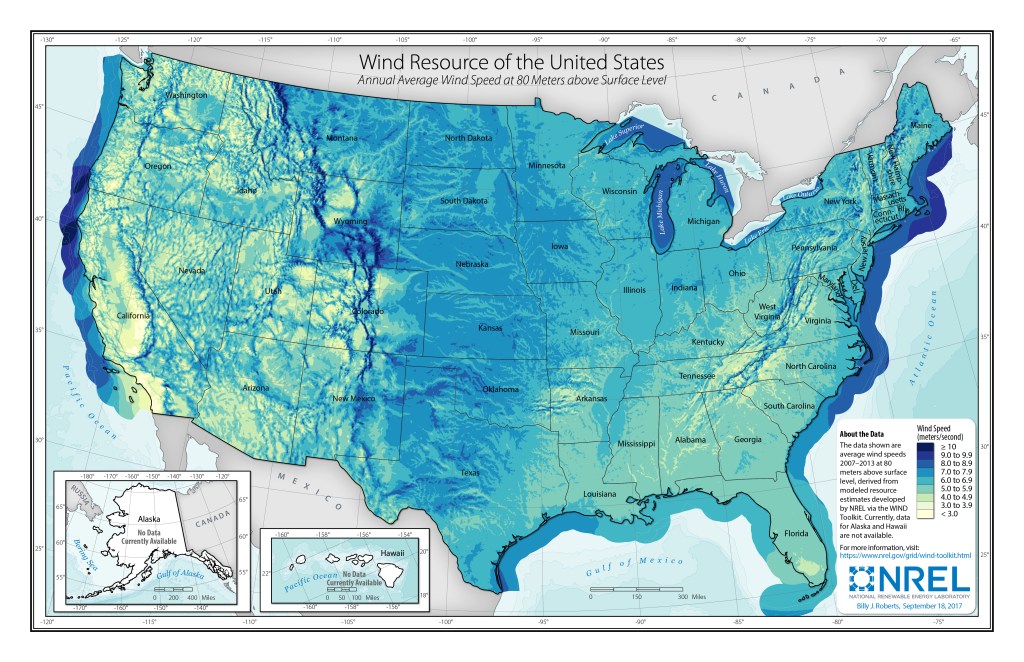
Wind energy potential is usually greatest in mountainous areas, across expansive plains and over the ocean as illustrated by the map below of the climatological wind resources of the continental US at 80 m above the surface.
source: https://www.nrel.gov/gis/assets/images/wtk-80m-2017-01.jpg
Offshore: While offshore wind energy is a significant growth area and most of the very largest turbines in operation are sited at offshore facilities, there are significant costs to creating and maintaining offshore wind farms. There is a great deal more installation cost to creating a wind farm offshore and to designing and implementing submarine transmission cables to convey the energy from the turbines to the communities on land that use the energy. There are additional maintenance and operational considerations as well. Generally, the downside risks of wind energy production offshore are reduced, although offshore turbines still are responsible for some bird kills.
 asclimateservices.org
